Composition VIII
Wassily Kandinsky · 1923 · Solomon R. Guggenheim Museum, New York
About the artwork
Composition VIII - 1923
The most-quoted abstract painting in the world
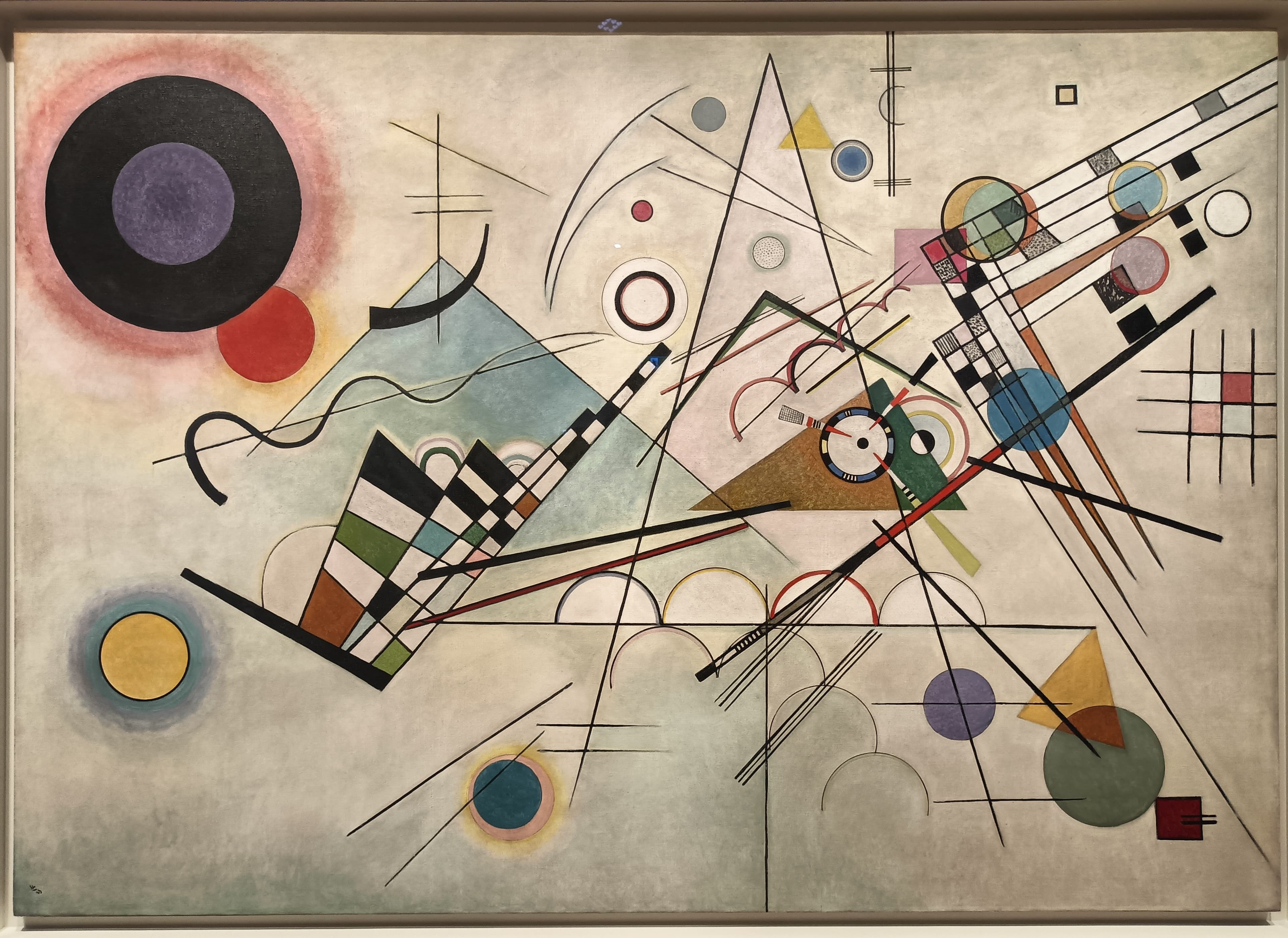
Composition VIII is the painting most people picture when they hear the word Kandinsky. It is the late-period abstract work, the one that pulls together his Bauhaus teaching in Dessau with his earlier mystical writings about painting as a kind of inner music. It is geometric, but not cold. It is cool, but not empty. It has the calm of a finished system.
Look at the upper half. A cluster of circles, triangles, and soft lines, all in pale blue, pink, and cream. The shapes are not floating randomly. They are arranged in pairs and trios, the way a composer writes two flutes and a cello. Kandinsky was a serious amateur cellist. The structure of the painting is the structure of chamber music.
Then the lower half breaks. Sharp black diagonals cut across the geometry, with a thick black curve in the center. The cool is interrupted by a hot event. The painting is a chord followed by a sharp dissonance, and a recovery. Over eight hours of slow looking, that rhythm becomes audible.
Composition VIII is one of the most reproduced images in twentieth-century art. It has been on the cover of art history textbooks for three generations. It is a Kandinsky that does not need to be introduced.
- Oil on canvas
- 140 × 201 cm (55 × 79 in)
- Solomon R. Guggenheim Museum, New York