About the artwork
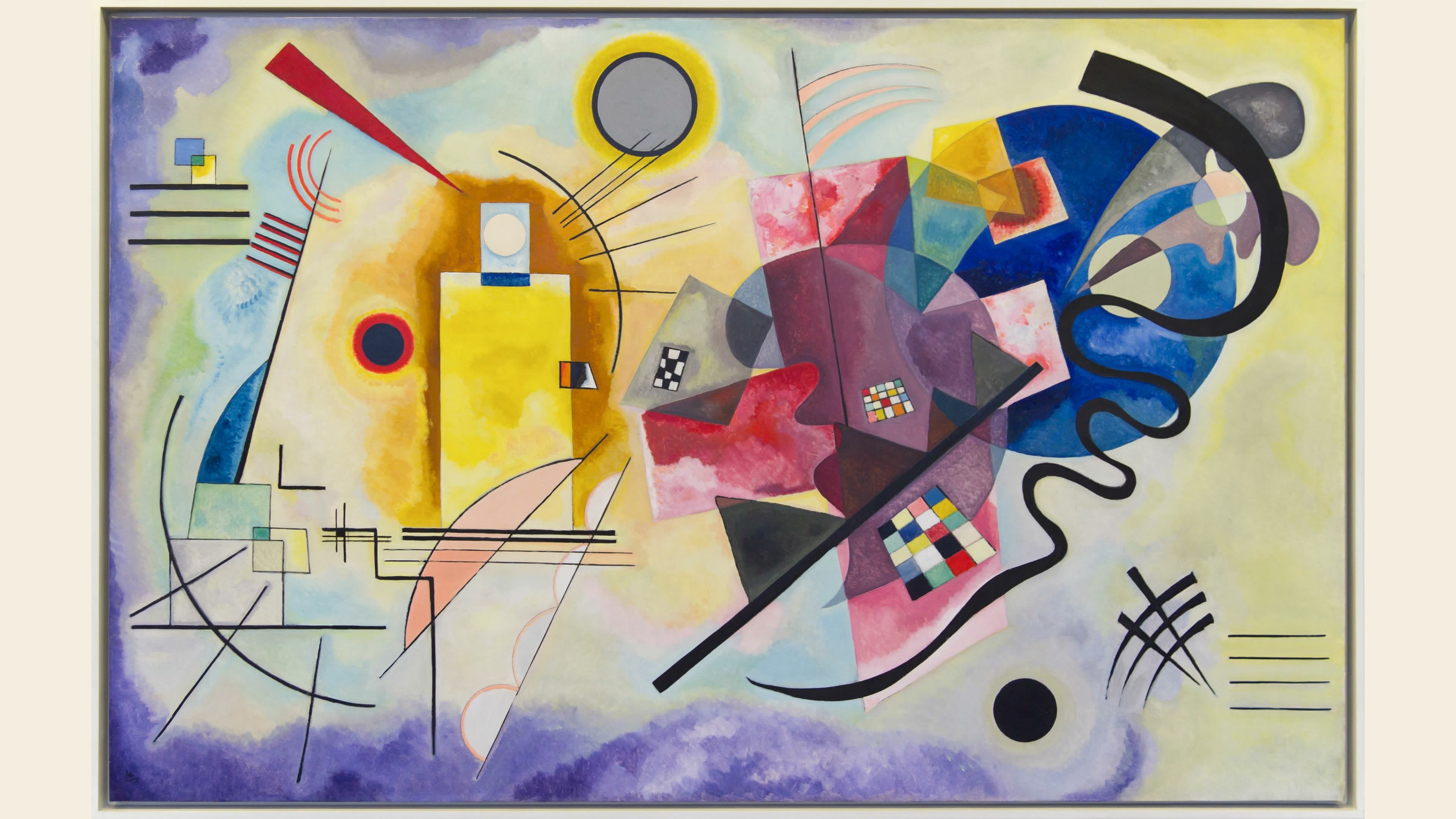
Yellow-Red-Blue - 1925
The year Kandinsky arrived at the Bauhaus
Yellow-Red-Blue was painted by Kandinsky in 1925, during his third year at the Bauhaus (he had joined the faculty in 1922) alongside Klee, Itten, and Albers. It is one of the cleanest statements of his mature De Stijl period - geometric forms layered over a soft, dusty palette of creams, pinks, and powder blues, anchored by warm accents of red, yellow, and orange.
The painting sits at the visual center of the Bauhaus curriculum. Kandinsky taught the introductory course on color and form, and his own paintings from this period doubled as his teaching examples. Yellow-Red-Blue shows his full vocabulary: the floating geometric forms, the layered translucency, the way a yellow square in the upper right can balance a red square in the lower left without any need for symmetry.
Look at how the lines work. They are thin and almost weightless. They feel like they were drawn with a draftsman's ruling pen, not a brush. The geometric forms sit on top of the lines, not against them. The whole composition is held in a kind of quiet equilibrium, the way a poem holds its rhymes - each element pulls against the others, but nothing ever quite wins.
After this painting, Kandinsky's work would shift toward more overtly mystical imagery - the cosmic landscapes of the late 1920s and 30s. Yellow-Red-Blue is the calm point before that shift. It is also, depending on how you look at it, a portrait of pure thought.
- Oil on canvas
- 127 x 200 cm (50 x 79 in)
- Centre Pompidou, Paris
- Public domain (artist died 1944)