About the artwork
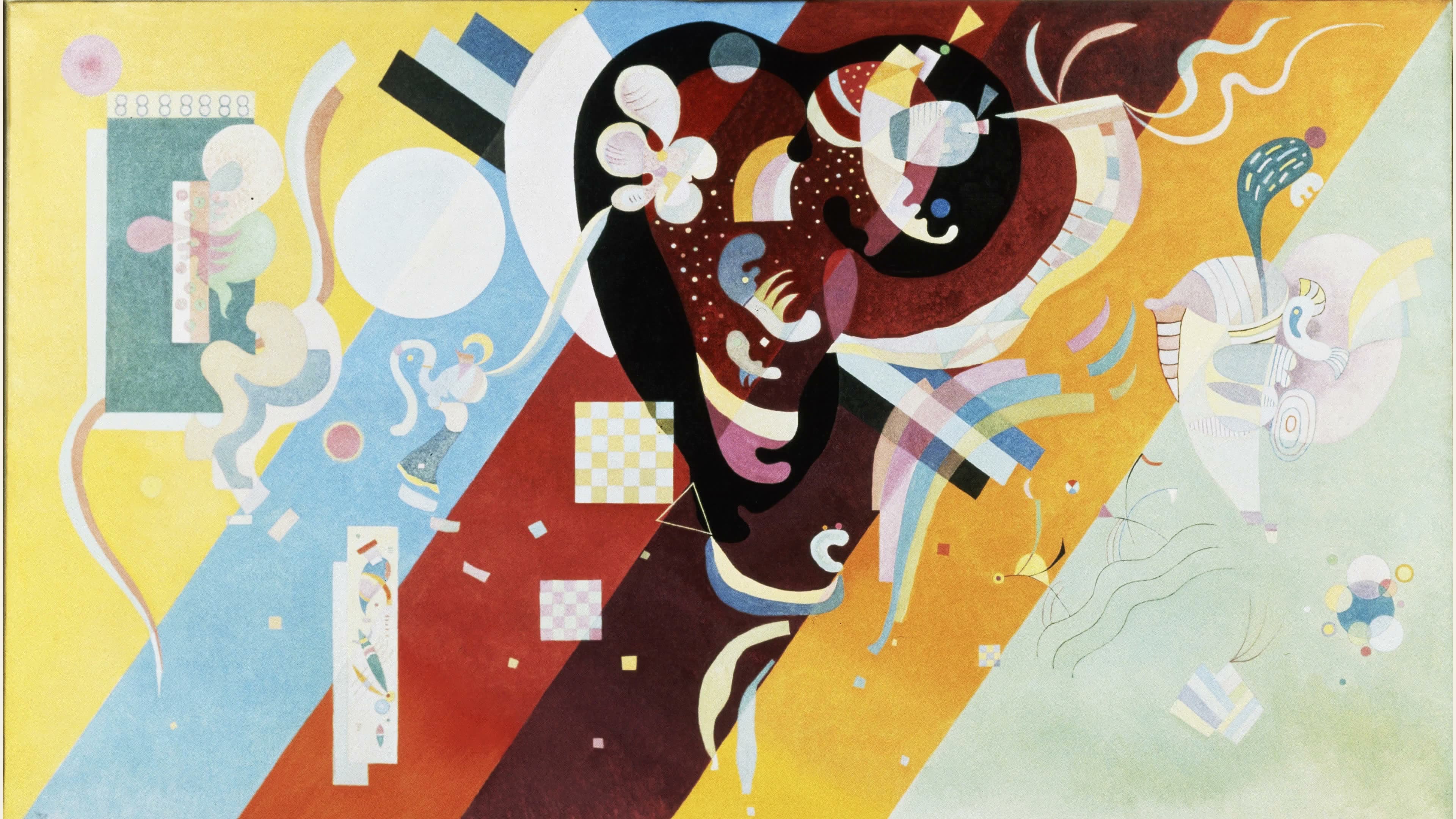
Composition IX - 1936
The capstone of the Composition series
Composition IX is widely considered the final masterwork of Kandinsky's Composition series, the seven large paintings he made between 1909 and 1939. By 1936, the Bauhaus had been shuttered by the Nazis for three years, and Kandinsky was living in Paris, painting in a calmer, more resolved visual language than he had used in the 1920s.
The painting is a study in quiet equilibrium. The angular geometries of his Bauhaus years have softened into rounded forms, and the saturated primaries of his earlier work have settled into a cooler palette of powder blues, pinks, and ochres. It is a late quartet - restrained, every element in conversation with every other.
This is the painting he wanted remembered as his last great statement. The Bauhaus had been forced to close in 1933. The political ground under European modernism was shifting. Composition IX was made in the eye of that storm.
The painting operates like a piece of late chamber music. There is no percussion, no dramatic event, no high volume. There is a kind of slow breathing across the canvas that rewards exactly the kind of long, patient looking that an eight-hour ambient video is built for.
- Oil on canvas
- 114 x 162 cm (45 x 64 in)
- Centre Pompidou, Paris