About the artwork
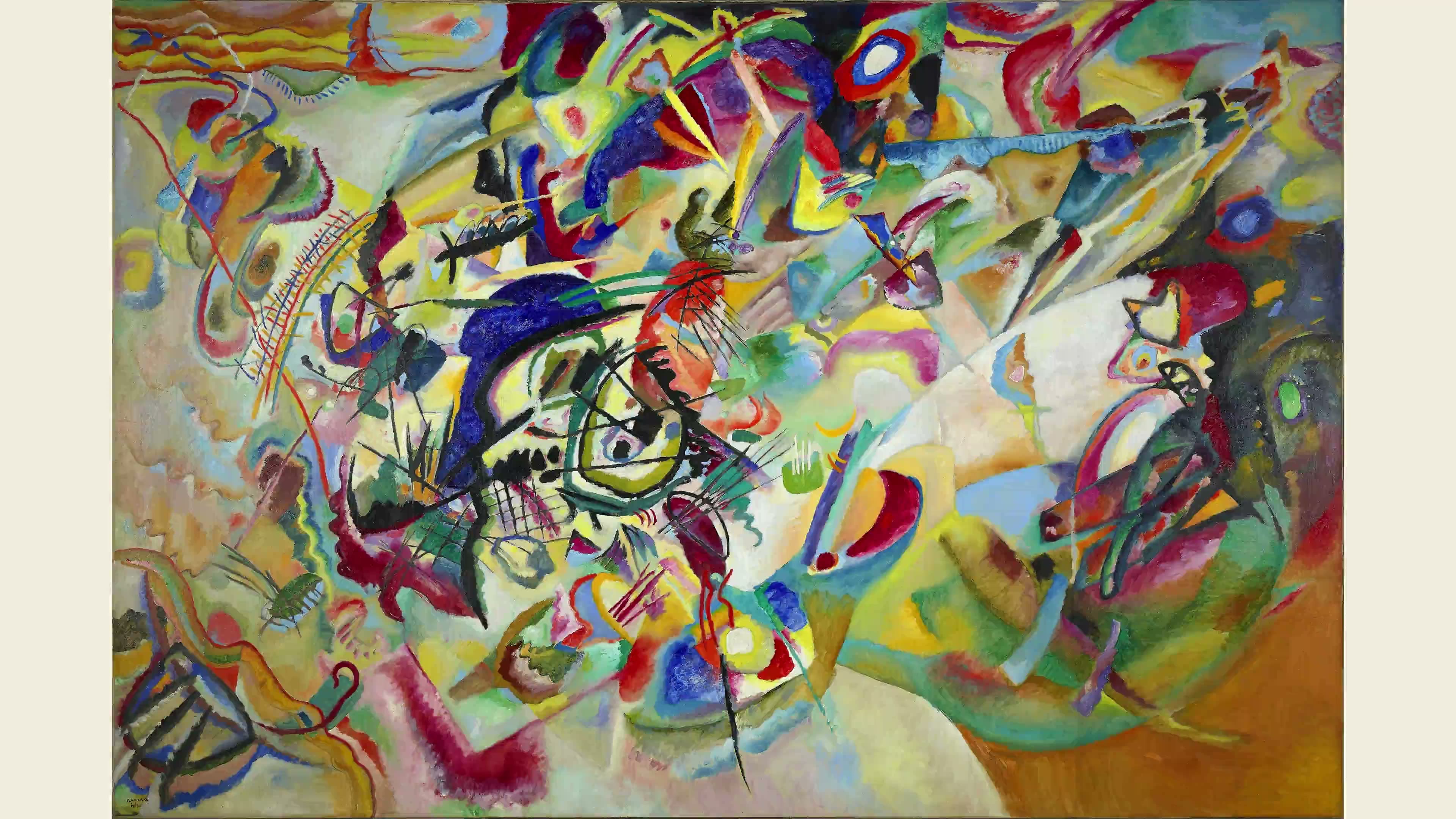
Composition VII - 1913
Three days that prefigured the end of the world
Composition VII was painted in late November 1913. Kandinsky was in his Munich studio, working in a state of intense concentration that he later described as almost involuntary.
What he produced was a painting that looks like a collision. Black lines slash across a field of pastels and muted color. Circles, triangles, and arcs tumble over each other. The center is dense and almost opaque with overlapping forms. The edges thin out into fragments of recognizable shapes.
Kandinsky called Composition VII the most complex painting he ever attempted. The canvas is large (200 by 302 centimeters) and there are over thirty preparatory studies on paper leading up to it. Many of those studies are themselves considered important abstract works in their own right.
What the painting depicts, if anything, is the theme of apocalypse and spiritual rebirth. Kandinsky had been writing about these subjects for years. The shapes in Composition VII have been read as boats, mountains, riders, trumpets, and auras. None of these readings is wrong. None of them is final either.
- Oil on canvas
- 200.7 x 302.3 cm
- State Tretyakov Gallery, Moscow